Chapter Three: The Weaponization of “Victim Mentality,” How the Term Can Harm Survivors and Perpetuate Abuse

“There are things which are within our power, and there are things which are beyond our power.”
Epictetus
“Victim mentality” gets thrown around carelessly. Sometimes it is used to shut survivors up. Sometimes it points to a real pattern of helplessness and externalization. If we do not separate those two things, we end up hurting people who need support and excusing patterns that keep people stuck.
Stoic philosopher Epictetus draws a distinction between what we can influence and what we cannot. That distinction can help us think about recovery without confusing responsibility for healing with blame for being harmed. What happened to a person matters. It may explain fear, shame, anger, or hypervigilance. But healing also asks whether the story stays a wound being processed or hardens into an identity that rules every choice.
When the Term Is Used as a Weapon
Survivors of abuse already face blame. De La Torre Laso and Rodriguez-Diaz showed how blame attribution shapes the psychological burden placed on victims of sexual violence [86]. Wegner and colleagues showed that perpetrators often rationalize what they did [87]. In that kind of climate, calling a survivor “stuck in victim mentality” can become one more way of shifting attention away from the harm and back onto the harmed person [86,87].
Knight makes a similar point in a different setting. In workplaces, people sometimes use a grievance-heavy posture to avoid responsibility, but careless labeling can also flatten real mistreatment into “they just feel sorry for themselves” [83]. The term needs precision for exactly that reason. A person telling the truth about what happened to them is not automatically avoiding accountability.
When a Victim Identity Does Become a Problem
There is also a real pattern people mean when they use this phrase carefully. Peterson and Seligman write about the importance of agency, responsibility, and the strengths that support recovery [85]. Gollwitzer and colleagues found that repeated victimization can stabilize victim sensitivity, which can make a person scan for danger and unfairness even after the original event has passed [84].
The original harm is still real. It means the injury can start shaping the person’s whole way of reading life. Like a smoke alarm that once saved you in a fire, the system may keep going off long after the room is safe. At that point, every conflict feels like persecution, every limit feels like betrayal, and every setback becomes proof that nothing can change.
A harmful victim identity usually shows up through patterns like these:
- the person cannot name any present choices, even small ones
- responsibility is always outside them
- feedback is heard only as attack
- helplessness becomes familiar enough that action starts to feel threatening
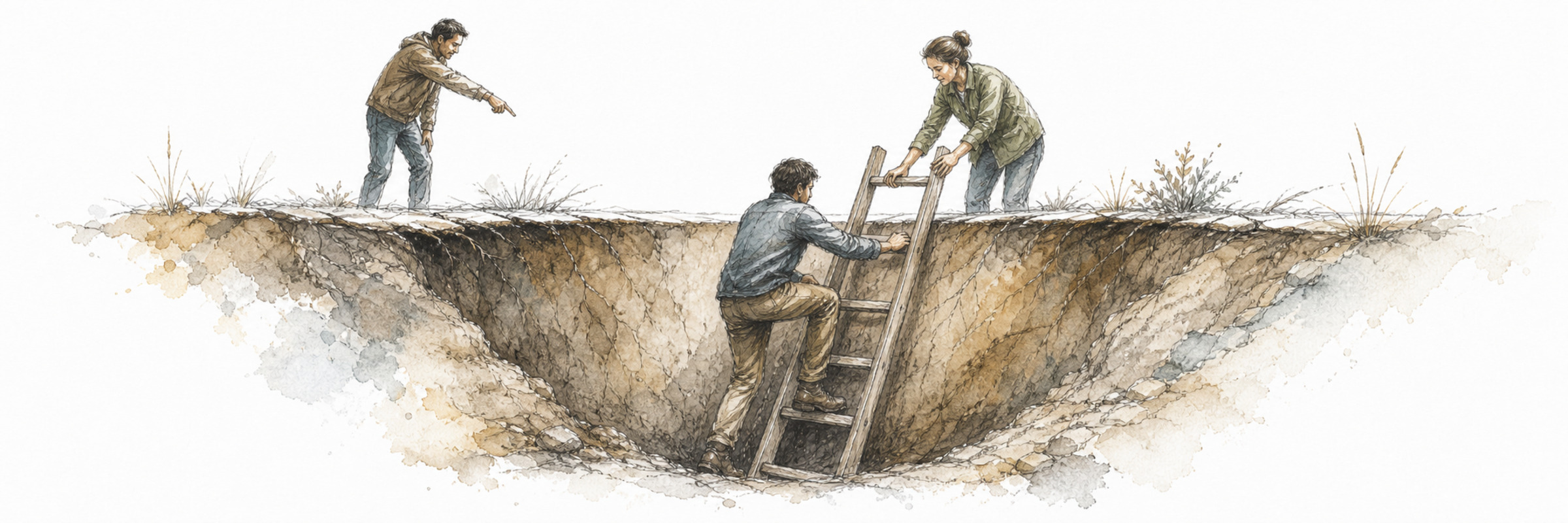
Even then, shame is not the cure. You do not help someone leave a hole by yelling at them for being in it. You help by telling the truth about the hole, the ladder, and the part they still have to play in climbing out.
How to Tell the Difference
A simple question helps: Is this person asking for reality, repair, and support, or are they building a permanent case for why nothing is ever theirs to face?
A survivor speaking honestly about abuse may need validation, safety, and time. A person trapped in victim identity may need something harder and kinder at the same time: compassion without collusion. Compassion without collusion lets you say, “What happened to you matters,” and also say, “What you do next still matters.”
The difference is not whether pain is real. The difference is whether pain becomes the whole operating system. One posture says, “I was harmed, and I am trying to heal.” The other says, “I was harmed, so I no longer have to examine my choices.” Those are not the same thing.
What Recovery Actually Looks Like After Real Victimization
Recovery after real victimization does not mean pretending the harm was small. It does not mean rushing forgiveness, acting cheerful, or never talking about what happened again. Real recovery usually looks quieter and steadier than that.
Recovery often looks like this:
- naming the harm clearly without minimizing it
- feeling the grief, anger, fear, or shame without making those feelings your whole identity
- asking for help without surrendering your judgment
- learning where your choices still live, even if they are small at first
- setting boundaries that protect you without turning every relationship into a courtroom
- becoming more able to tell the story without reliving it every time
Peterson and Seligman’s work on strengths is useful here because recovery is not only about symptom reduction [85]. It is also about rebuilding courage, perspective, self-regulation, honesty, and agency. Gollwitzer and colleagues help explain why this can take time [84]. When victim sensitivity has been reinforced by real harm, the nervous system does not calm down just because someone tells it to.
A simple analogy may help. After a serious injury, healing does not mean the body forgets what happened. Healing means the wound closes, strength returns, and the injured part no longer controls every movement. Psychological recovery is often like that. The scar may remain. But the scar does not have to become your name.
Handle the Term with Care
The phrase “victim mentality” should never be used as a lazy insult. Used carelessly, it becomes victim blaming and gives cover to abusers [86,87]. Used carefully, it can name a real barrier to recovery: a point where pain has started to swallow agency [84,85].
If you want to help someone well, hold both truths at once. Take harm seriously. Refuse cheap blame. But also remember that healing is not only about being understood. At some point it is also about rebuilding choice, responsibility, and the ability to act again. Dignity starts returning there.