Chapter Twenty-four: Travel, Self-Discovery, and the Impact on Relationships

“For my part, I travel not to go anywhere, but to go. I travel for travel’s sake.”
Robert Louis Stevenson
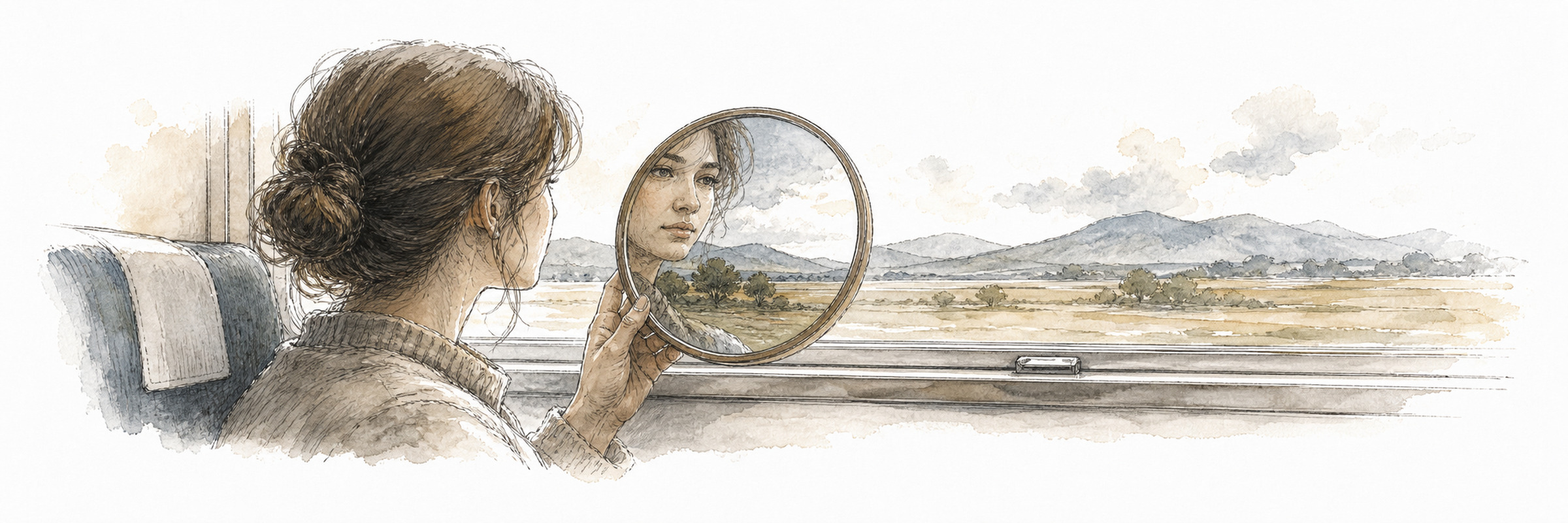
Writer and traveler Robert Louis Stevenson understood that travel could be valuable even without an impressive destination. Travel does more than move your body from one place to another. It can widen your perspective, expose your habits, and show you who you become when the usual routines disappear. This chapter is about what travel can teach us about ourselves, our desires, and our relationships.
Why Travel Changes People
Travel interrupts habit. It puts you in new places, asks you to solve unfamiliar problems, and forces you to see what you usually move past without noticing. Zimmermann and Neyer found that time spent abroad can influence personality development, including openness, agreeableness, and emotional stability [352]. Not every trip changes a person for the better. What travel does reliably is hold up a mirror.
Travel is also a magnifying glass. It tends to make good patterns more visible and bad patterns harder to hide. Patience, generosity, flexibility, entitlement, avoidance, and emotional maturity all show themselves more clearly when plans break, money gets tight, or people are tired and out of their comfort zones.
Travel matters in relationships for exactly that reason. Durko and Petrick found that satisfying travel experiences can strengthen relationship investment [353]. Holman and Jacquart found that shared leisure matters for marital satisfaction [354]. In plain language, a good trip can strengthen a bond, not because the airport is magic, but because shared novelty, teamwork, and memory-making can deepen connection.
Travel can also expose a weak bond. If communication is poor, if one person dominates, if resentment is already simmering, or if the relationship depends on comfort and predictability to stay calm, a trip may bring that to the surface quickly. Seeing the weakness is not always a bad thing. Sometimes discomfort is how truth finally gets enough room to show itself.
Stepping Out of Your Comfort Zone Without Losing Your Center
Growth usually asks for some discomfort. But discomfort by itself is not wisdom. You do not have to do every unfamiliar thing just because it feels brave. Healthy stretching is different from reckless self-betrayal.
The need for clear judgment matters even more when new experiences involve relationships, sexuality, or changing agreements. Sometimes growth means trying a new city, a new language, a new hobby, or a new social setting. Sometimes it means having a conversation you have been avoiding about desire, fantasy, attraction, or fear. The point is not to force novelty. The point is to become more honest.
Justin Lehmiller’s work on sexual desire reminds us that trust, openness, and explicit communication matter when people explore new parts of their sexual lives [355]. The same rule applies whether you are monogamous, ethically non-monogamous, or trying to figure out what kind of relationship actually fits you.
If you want to explore safely, a few habits help:
- talk before you act
- be specific about boundaries, not vague about them
- start smaller than your ego wants to
- create a real way to pause, stop, or revisit the plan
- talk afterward about what felt connecting, what felt off, and what should change
Sexual exploration works the same way. Books, workshops, trusted educators, and honest conversations with a partner can all help more than impulsive experimentation. Curiosity grows best in safety.
If Bisexuality Is Part of the Conversation
If bisexuality becomes part of the conversation, it helps to slow down and separate a few things that people often mash together. Orientation is one question. Behavior is another. Relationship agreements are another. A bisexual person is not automatically asking for non-monogamy, and a monogamous agreement does not erase bisexuality.
What helps here is honest, non-defensive conversation. Talk about attraction, identity, fear, grief, curiosity, fantasy, and agreement. Challenge the lazy stereotypes too. Bisexuality is not a phase, not proof of promiscuity, and not a character flaw.
If you want more on this part of the conversation, Lisa Diamond’s Sexual Fluidity, Janet Hardy and Dossie Easton’s The Ethical Slut, and Robyn Ochs’s Getting Bi can give you a wider frame for thinking about bisexuality, fluidity, and relationship structure.
Learning From Other Cultures Without Romanticizing Them
Travel also teaches by contrast. When you spend time in other places, you start noticing which parts of your worldview are moral convictions and which parts are just familiar habits. A shift like that can be healthy. It can make you less arrogant and more curious.
History and culture show a wide range of relationship norms. Zeitzen’s work on polygamy reminds us that different societies have organized love, family, and commitment in different ways [356]. Taormino’s work on open relationships helps frame one modern form of ethical non-monogamy [336]. Helen Fisher has also argued that human beings appear capable of more than one attachment pattern, with biology, culture, and personal history all shaping how people bond [357].
None of this means every tradition is good, or that every unfamiliar relationship structure is wise. It also does not mean you have to copy what you see somewhere else. The point is humbler than that. Travel can loosen the grip of “the only normal way is my way.”
If you want more reading on this broader question, Miriam Zeitzen’s Polygamy, Elisabeth Sheff’s The Polyamorists Next Door, and Christopher Ryan and Cacilda Jetha’s Sex at Dawn can all widen the frame, even when you do not end up agreeing with all of their conclusions.
Travel as a Relationship Test and Teacher
Travel can strengthen a relationship because it creates shared stories, shared problem-solving, and shared perspective [353,354]. It can also expose where the relationship is weak. A couple who communicates well at home may communicate poorly when exhausted, lost, jealous, or financially stressed. Weak spots revealed under pressure are useful data.
The same thing is true in non-monogamous relationships. Travel can open space for new conversations about time, access, privacy, jealousy, fairness, and logistics. If multiple partners are involved, the planning burden usually goes up, not down. Travel can be clarifying for exactly that reason. It shows whether the people involved know how to be honest, flexible, and considerate under pressure.
One simple analogy helps here: travel is like taking a relationship out on wet roads instead of a dry parking lot. You find out pretty quickly whether the tires have tread, whether the brakes work, and whether the two of you know how to steer together.
Bringing the Lessons Home
Travel matters for what happens while you are gone, but the deeper value is what you bring home with you. Reflection matters there.
Rusbult and Van Lange’s work on interdependence helps here [359]. Healthy relationships need both connection and individuality. Travel can support that balance when people use it well. It can help you remember that closeness does not require sameness and that growth does not require disconnection.
If you want the trip to matter after the trip ends, a few practices help:
- reflect on what the experience exposed in you
- tell the truth about what the trip strengthened and what it revealed
- stay open to change without chasing chaos for its own sake
- keep a few practices from the road, such as mindfulness, curiosity, or better conversation [242]
- use what you learned to build a more honest relationship, not a more impressive story
Gottman, Silver, Markman, and colleagues all make the same basic point in different ways: relationships grow when people communicate honestly, manage conflict well, and stay engaged in each other’s inner worlds [54,319]. Travel can help with that, but only if the lessons become practice after the suitcase is unpacked.
If you want a reflective companion for that part, Cousineau’s work on pilgrimage is useful because it treats travel as attention as much as movement [360]. The deeper invitation here is attention over mere motion. Travel can make you more interesting, but better than that, it can make you more awake.
For an extended bibliography covering travel, self-discovery, ethical non-monogamy, and monogamy, see the References section in Ethical Non-Monogamy - Navigating Relationship Boundaries (Chapter Twenty-two).